

Not Losing The Bottle
UK recycling is improving, but it's still got a long way to go. Consistency would be a great help.


Before we talk about net zero, circular economy, resource efficiency or sustainable consumption, perhaps we should talk about a bottle.
Not a fancy bottle. Not a smart bottle. Just an ordinary glass bottle sitting on a kitchen counter after the contents have long since disappeared.
A friend of ours recently moved house. Not far. From Corfe Mullen in East Dorset to just across the council border into the outskirts of Poole, domain of the ‘acrimonious’ BCP — Bournemouth, Christchurch & Poole. A journey of just a couple of miles.
The bottle, however, appears to have travelled much further.
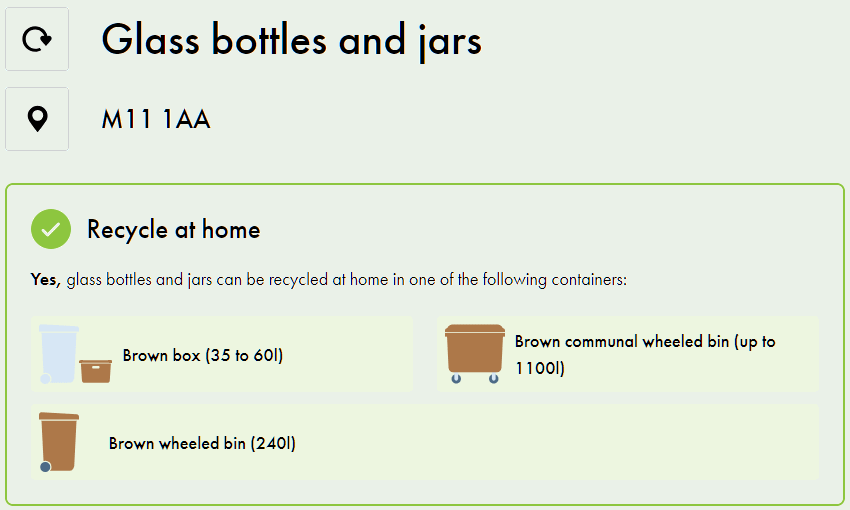
In Corfe Mullen, recycling it was straightforward. Empty bottles went into a green crate, picked up from the kerbside every couple of weeks, bish bosh.
In Poole, though, things are less obvious. The guidance is there if you go looking for it, but bottles seem to arrive almost as an afterthought within a broader recycling scheme. There are no separate boxes. Everything goes into a mixed recycling stream and is sorted later.
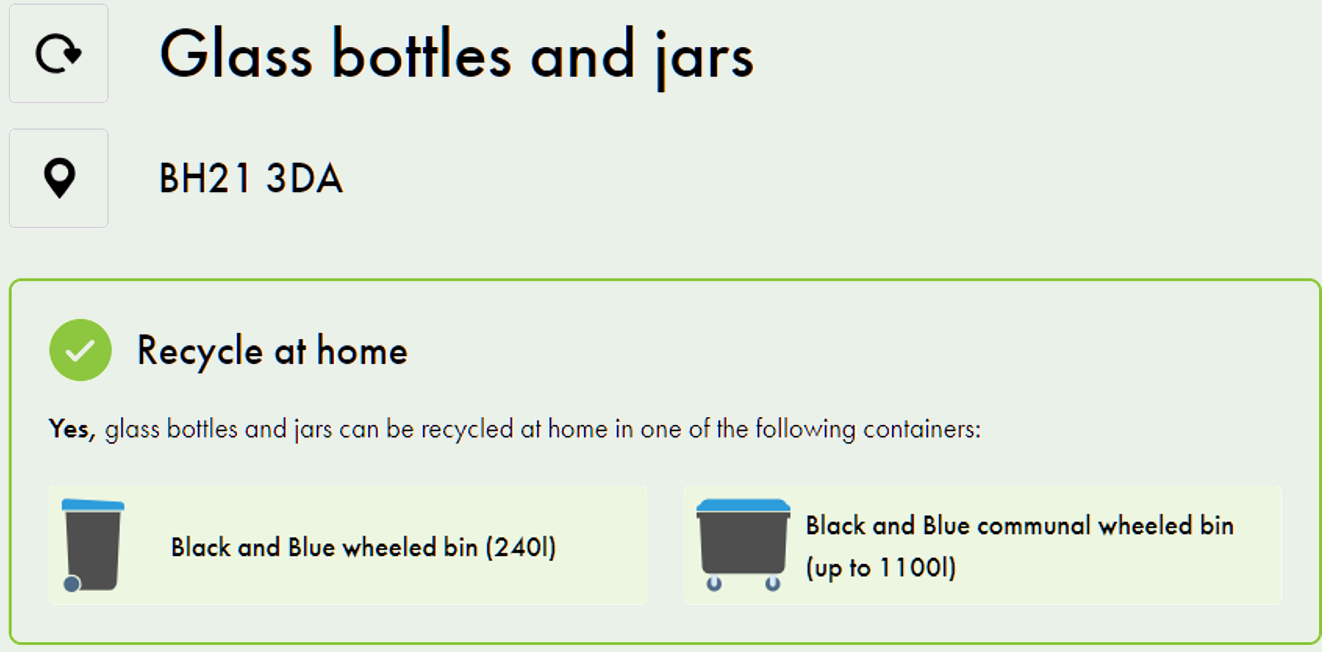
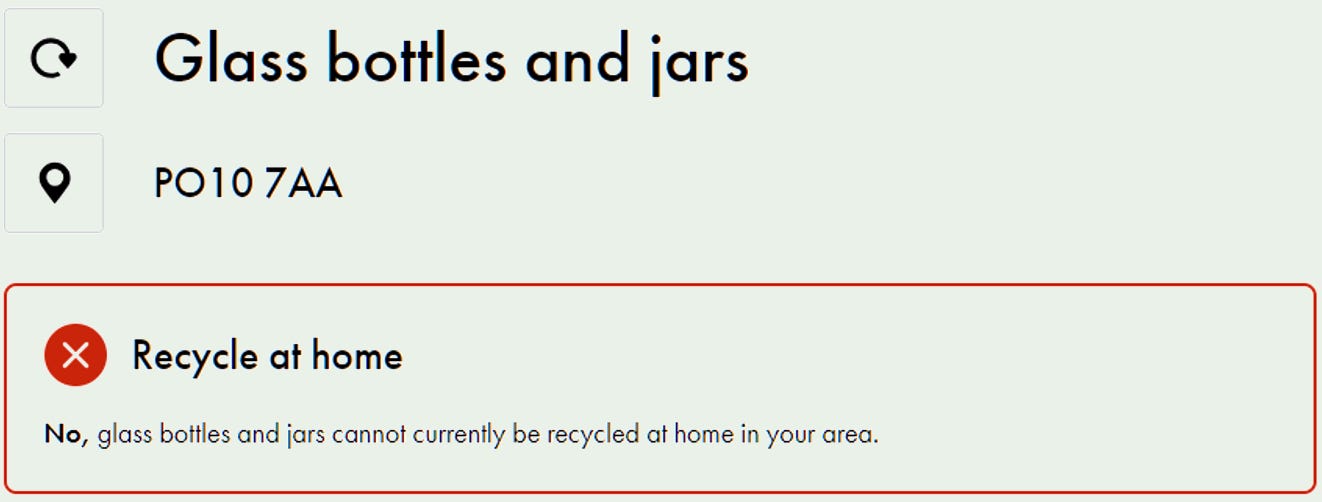
Travel a little further east and the story changes again. In Portsmouth, residents are directed towards bottle banks rather than putting glass into household recycling collections.
Three parts of southern England with but a short hop across the New Forest between them, traffic permitting, of course. Three different ways of dealing with the same object.
Which raises the question: why?
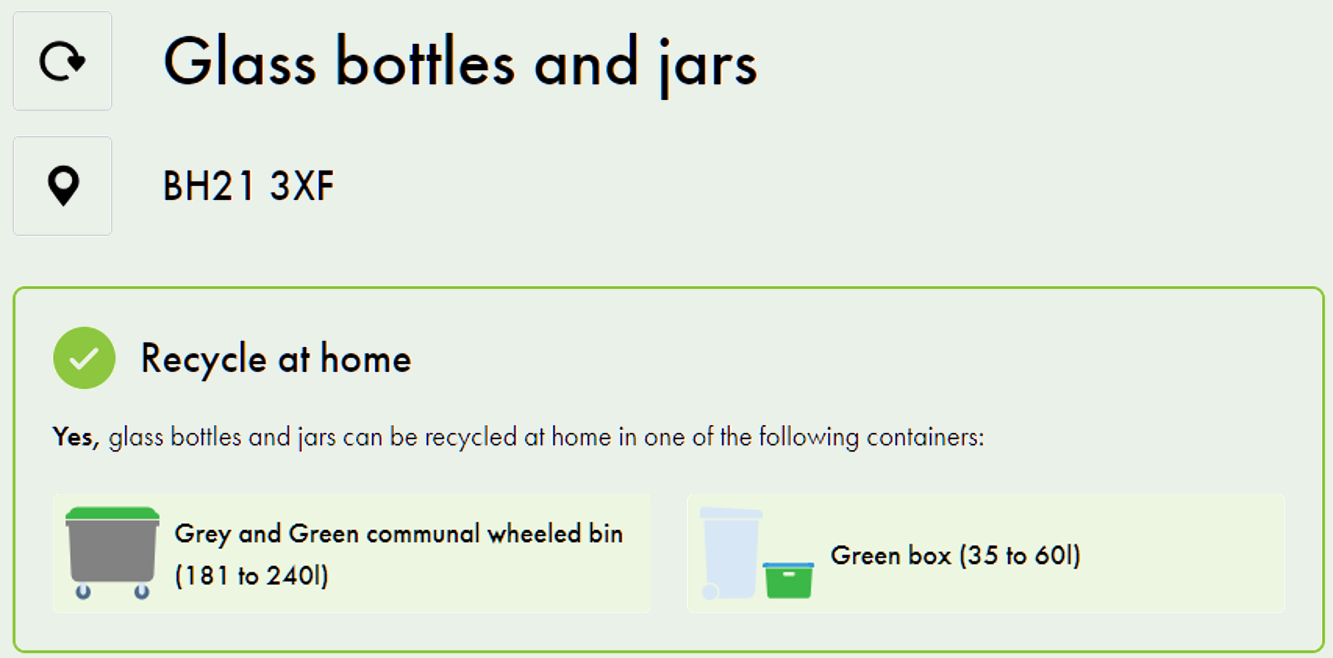
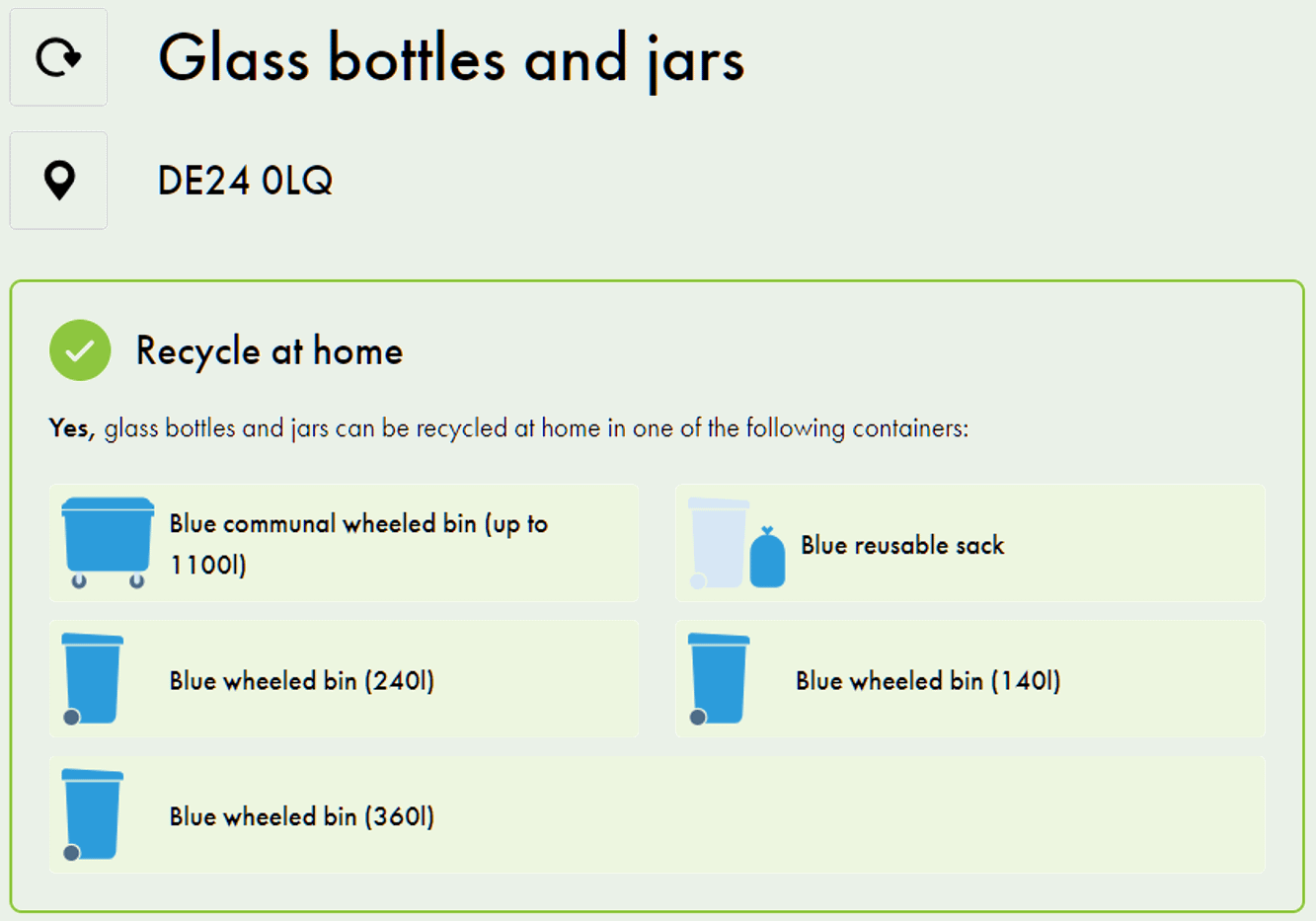
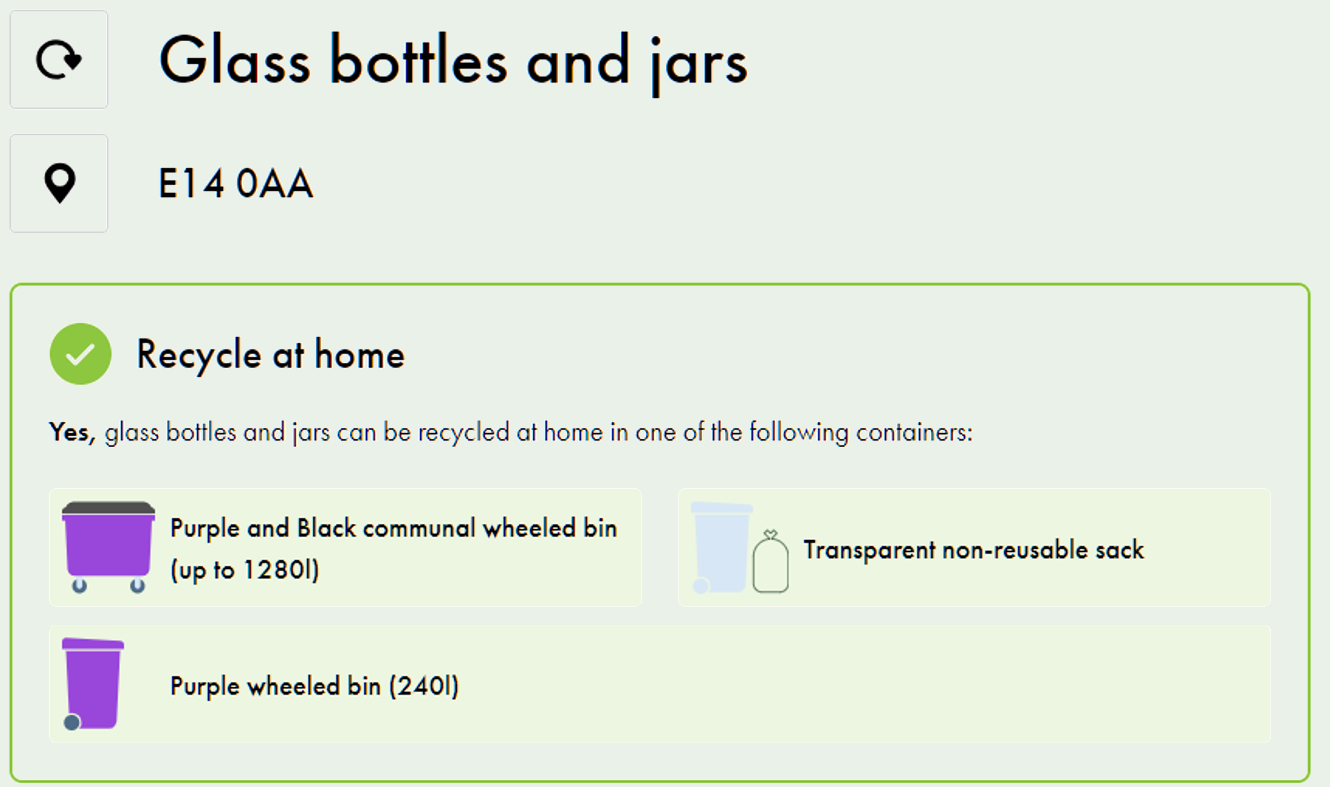
All images of this type: Recycle Now
Most of us assume recycling is a national system. It isn’t.
What we actually have is hundreds of local systems operating within a broad national framework. The result is a patchwork of arrangements that can look surprisingly different from one council boundary to the next.
Some authorities collect glass separately. Others collect it alongside paper, plastic and metal. Some rely heavily on bottle banks. Collection frequencies vary, bin colours vary, and even the lists of accepted materials can vary.
Move house and you may discover that yesterday’s good recycling habit has become today’s contamination risk.
A yoghurt pot that can be recycled at home in one authority needs a map to find a bin in another. A black plastic tray that was rejected in one place is perfectly acceptable somewhere else. Food waste collections are increasingly common but still not universal. Cartons drift in and out of accepted materials lists depending on where you happen to live.
The public are often blamed for confusion; in truth, the confusion is frequently built into the system. It’s a circular economy with almost the same number of different dialects as England itself.
And that seems to us to be a bit daft.
Recycling relies on participation. People need to know what to do, but perhaps more importantly they need confidence that what they are doing is actually correct. Every exception creates a little uncertainty. Every contradictory instruction creates a little doubt. Over time those doubts accumulate.
The circular economy is often presented as a technical challenge. Better materials, better product design and better recovery systems all have an important role to play.
Yet—as we’ve commented many times here on The Green Edge—it’s also a behavioural challenge.
Most people are not experts in waste management, nor should they need to be. The ideal recycling system is one that works without requiring householders to develop a detailed understanding of local authority procurement decisions or materials processing technologies. At the moment, however, many residents are expected to do exactly that.
There is something especially odd about this when it comes to glass, because glass is hardly a new recycling problem. Glass has been doing the rounds for a very long time. The older ones among us will no doubt remember the pint bottle on the doorstep, obligingly filled with unhomogenised milk to give the sparrows a life-preserving energy shot of cream in the cold winters of the sixties and seventies. Full bottle in, empty bottle out. Repeat until childhood becomes nostalgia.
Soft drinks had their own version. Take the bottle back and get the deposit returned. It was simple, direct and hard to misunderstand — although the Scottish Government and Biffa between them seemed to lose the plot on it a year or two back.
The technical term for recycled glass is cullet, which sounds like something a medieval barber might attempt, but is actually central to glass manufacturing. Cullet can be fed back into furnaces to make new glass. It reduces the need for virgin raw materials and cuts the energy required in production.
In other words, glass recycling was never just an environmental gesture. The incentives lined up. Households always had a reason to return the bottle. Manufacturers always had a reason to use the recovered material. The bottle always had value.
That may be the most interesting part of all. We sometimes talk about circular economy as though it were a new idea waiting to be discovered in a consultancy slide deck. Yet the milk bottle on the doorstep was already circular. So was the deposit bottle. So, in its own way, was the old rag-and-bone economy.
Not everything old was better, obviously. There were plenty of bad old systems we should be happy to leave behind. But on glass, we have known for a long time that return and reuse can work when the incentives are clear.
So, why do today’s differences exist?
The obvious explanation is that councils are doing things differently because they want to. The reality is usually rather less dramatic. Local authorities inherited different infrastructure, signed different contracts and invested in different facilities at different points in time. A council that committed to one sorting technology ten years ago may still be working within the constraints of that decision today.
Waste management is also a surprisingly complex supply chain. A bottle leaving the kitchen embarks on a journey through collection systems, transfer stations, sorting facilities and processing plants before eventually reappearing as a new product. The route depends on local arrangements. What feels inconsistent to a resident may be entirely logical to an operations manager trying to make a long-term contract work. Yet that does not make the inconsistency any less frustrating, because most residents don’t have the slightest interest in the supply chain. They just need clear instructions.
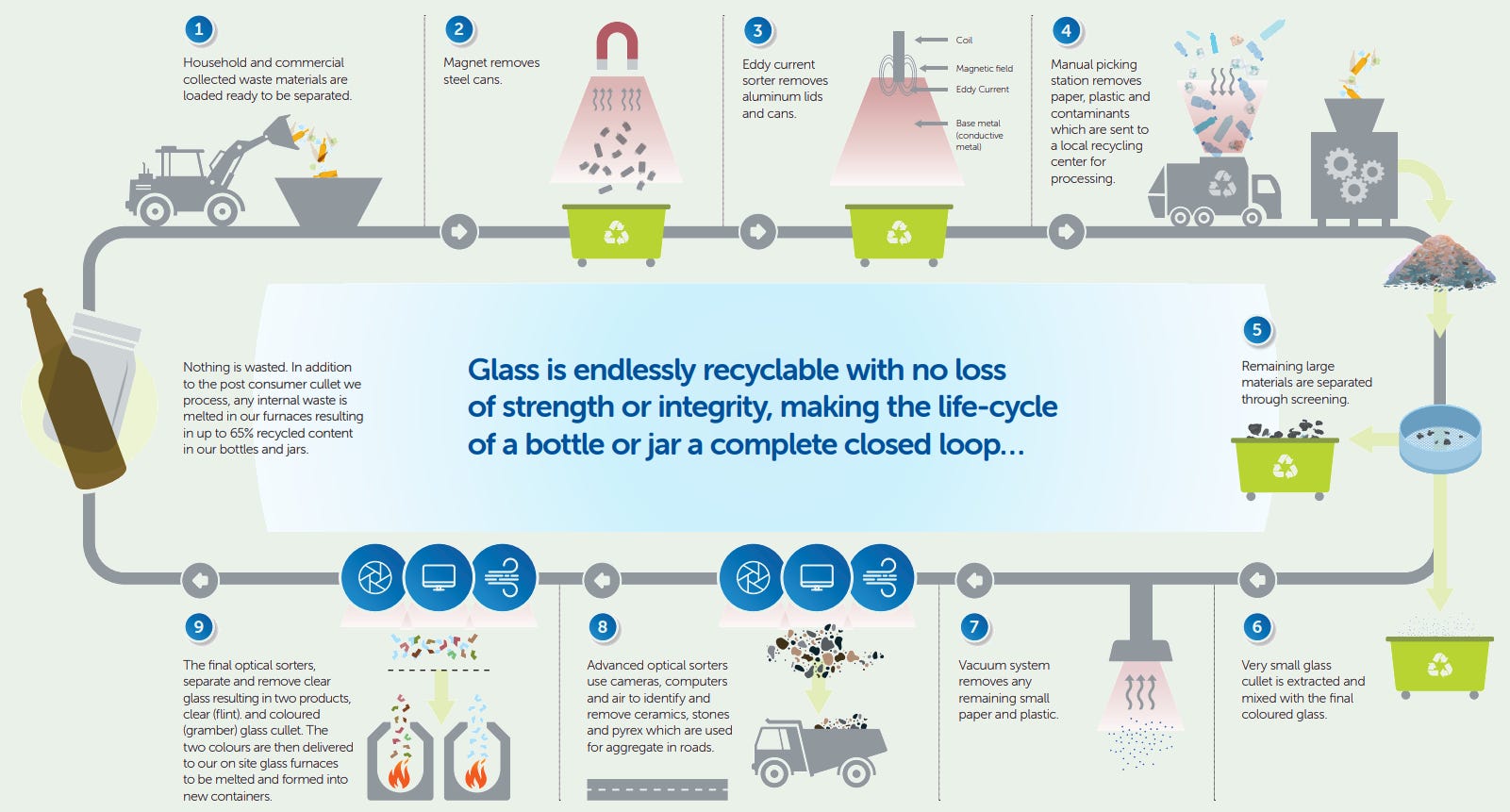
Image: Beatson Clark
There is also another factor with glass, and it deserves a little more sympathy than we usually give it. Glass breaks. That sounds obvious, but it matters. A bottle is useful, clean and valuable while it is whole. Once smashed, it becomes something else. It becomes sharp. It becomes awkward. It becomes a hazard for the people who collect, lift, tip, sort and process our waste.
Waste and recycling work is not genteel work. It is physical, repetitive and sometimes risky. Collection crews handle heavy containers in all weathers. Sorting operators work around machinery, moving belts and materials that households have not always prepared as requested. Add broken glass to that mix and the design of the collection system starts to look less like a minor administrative choice and more like a health and safety decision.
But that doesn’t mean that administrative waste doesn’t happen. This is Britain, remember? While the environmental movement might focus on visible waste — discarded packaging, overflowing bins and littered streets — fragmentation in administration creates duplicated communications, separate education campaigns, different websites, different leaflets and different customer support systems. It creates confusion whenever people move home and uncertainty whenever national campaigns attempt to encourage recycling behaviour. All of that consumes time, money and effort.
The irony is hard to miss. We spend enormous amounts of energy trying to standardise products and processes across the economy, yet one of the most visible parts of everyday environmental action remains stubbornly fragmented.
The Government’s Simpler Recycling programme is intended to address some of this inconsistency, at least in England. The aim is not necessarily to make every bin look identical. Instead, the ambition is to create greater consistency in the materials collected from homes and businesses, making recycling easier to understand wherever people happen to live. That should help. If the same materials are accepted in more places, communication becomes simpler, participation becomes easier and public confidence has a chance to grow.
“Effective waste management” may not be the most exciting phrase in the sustainability vocabulary. Neither, for that matter, is “simpler recycling”. But both are more important than they sound. Recycling succeeds when it becomes boring. When residents no longer have to think about it. When the right action becomes the obvious action.
As Mark Knopfler said, we’ve been banging on the bottles like chimpanzees in this post. But the bottle is really just a symptom. The larger story is about fragmentation.
We see similar patterns elsewhere. Energy efficiency schemes differ between regions. Planning rules vary between authorities. Transport systems often stop abruptly at administrative boundaries. Skills programmes are frequently designed around funding streams rather than learner journeys. Even within sustainability itself, we often encounter a landscape of overlapping initiatives that make perfect sense individually but feel bewildering collectively.
The challenge is rarely a lack of effort. If anything, there is too much of the stuff. The challenge is coordination. How do we create systems that feel coherent from the perspectives of the people using them?
That question may matter more than any individual recycling target because people do not experience policies. They experience systems, and systems are ultimately judged by whether they make everyday life easier or harder.
So, thinking about our bottle offers — to us at least — a useful message. A good system is not just one that collects more material. It is one that collects the right material, in the right condition, with the fewest avoidable risks along the way.
Too much broken glass in the wrong place can make life harder for collection crews and sorting staff. Too much contamination can reduce the value of the material. Too many local exceptions can cause residents to give up trying to understand the rules.
So the answer is not simply to say: collect everything from everywhere in exactly the same way. Local conditions apply. Existing infrastructure needs to be worked with, and in some cases worked around. Worker safety can’t be ignored.
But consistency matters too.
So for my postcode you are showing black and blue bins… which one should i actually use? Blue is designated recycling, black is for refuse. Even more confusing as there aren’t any multicoloured ones… glad I inspired a post!